
Is basement underpinning worth it Toronto homeowners? In many cases, yes. But the value comes from what the basement becomes after the work is complete, not from the digging itself. This guide explains when underpinning makes financial and practical sense, what affects cost, and how to decide whether lowering your basement is the right move for your home.
Is basement underpinning worth it Toronto?
In many Toronto homes, the basement is the one part of the house with the most unused potential and the most unanswered questions. It is the space under your feet, but it can also be the space that keeps a family from moving, helps create rental income, or finally gives an older home the room it has been missing.
That is why homeowners often ask one direct question before calling a contractor: Is basement underpinning worth it Toronto? The answer is yes in the right house, for the right reason, with the right renovation plan. But it is not a casual upgrade. It is structural work, and it deserves more thought than a simple cost-per-square-foot estimate.
Basement underpinning can be worth it when a home has low ceiling heights, an aging basement foundation, limited living space, strong resale potential, or a realistic plan for a legal basement or finished lower level. It can also be a mistake when the basement already works well, the budget is too thin, or the project starts without proper engineering, permits, and a clear end use.
For West Toronto homeowners, this decision is often personal. They may love the street, the school district, the short walk to transit, or the character of the house. What they do not love is the cramped basement, the low beams, the damp smell, or the feeling that moving is the only way to get more space. That is where a careful underpinning plan can change the conversation.
| Quick answer | What it means for Toronto homeowners |
| Is basement underpinning worth it Toronto? | Yes, when it creates useful living space, supports a legal basement plan, improves long-term value, or helps the family avoid moving. |
| When is it not worth it? | When the basement already has good height, the space will rarely be used, or the total project cost does not match the home’s value. |
| What affects cost the most? | Depth, square footage, access, soil conditions, waterproofing, plumbing, engineering, permits, and final finishes. |
| What should come first? | A site visit, structural review, budget discussion, and a clear plan for how the basement will be used. |
The value comes from what the basement becomes after the work is complete, not from the digging itself. A low basement floor with exposed pipes, uneven concrete, poor lighting, and barely enough headroom does not add much comfort to a home. A dry, properly planned lower level with better ceiling heights, safe stairs, good drainage, insulation, lighting, and a clear purpose can feel like the house finally gained another floor.
That difference matters. Underpinning is worth it when it turns wasted square footage into space the household will actually use. It might become a family room, office, gym, guest suite, playroom, laundry zone, or legal basement apartment. It can also support future flexibility, which matters in Toronto homes where family needs change, but moving is expensive.
This is the kind of decision Ashford Homes often helps West Toronto homeowners think through before construction starts: not just whether the basement can be lowered, but whether the new space will make the whole home work better.
The goal is not simply a deeper basement. It is a lower level that feels planned, useful, dry, safe, and connected to the way the family actually lives. Homeowners can explore that broader renovation approach through custom home renovation services.
The better question is not only whether the underpinning can be done. The better question is whether the new lower level will improve the home enough to justify the investment.

What does basement underpinning actually do to an older Toronto home
Basement underpinning is a structural method used to deepen or strengthen an existing foundation. The City of Toronto describes residential underpinning as work that increases the depth of an existing foundation by constructing new footings beneath the existing footings. The City also notes that underpinning can reinforce an existing foundation or support the addition of a below-grade or partly below-grade entrance.
In plain English, underpinning lowers the basement floor while keeping the house supported. The contractor does not dig out the whole basement at once. The work is completed in stages, so the existing foundation remains stable while new foundation sections are built below it.
That staged process is the reason this work should never be treated like ordinary basement finishing. A poor flooring choice can be replaced. A poor foundation decision can affect the whole house.
The City of Toronto explains that the angle of repose is the maximum angle at which soil remains stable, and that this angle changes based on soil conditions. It also advises homeowners to consult a professional if construction exceeds the guidelines or if the soil type is unknown.
That official warning is the expert layer homeowners need to hear: if the soil, foundation, and adjacent structures are not properly considered, the risk is not cosmetic. It is structural.
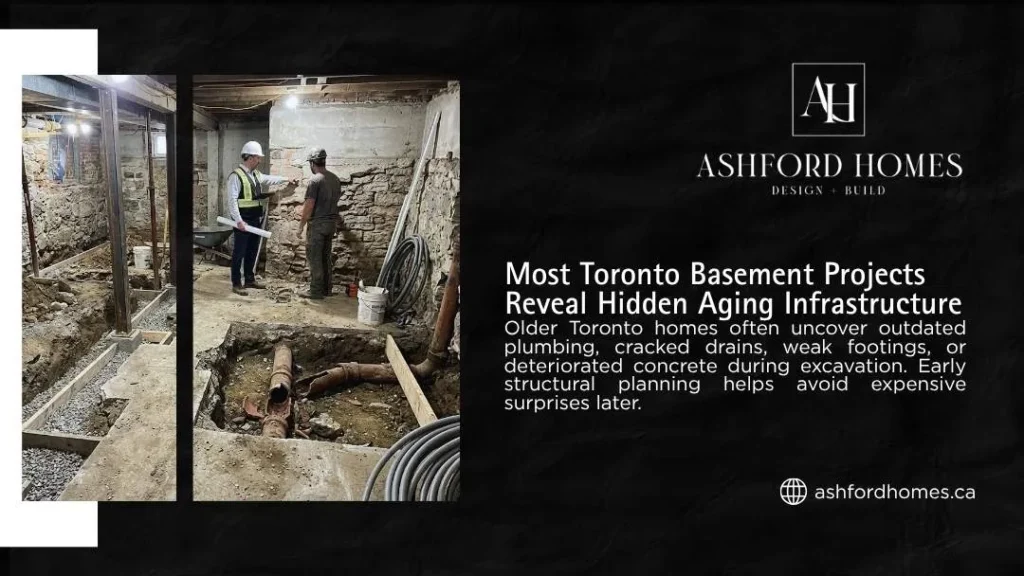
For older Toronto homes, this matters even more. Many have shallow footings, mixed foundation materials, narrow lots, party walls, older drains, past water problems, and tight access. A basement underpinning Toronto project may also affect plumbing, HVAC, stairs, waterproofing, structural posts, and future finishing.
This is where Ashford Homes can stand apart from a basement-only contractor. A good underpinning plan does not stop at the concrete. It asks how the new lower level will connect to daily life upstairs, how it will look, how it will stay dry, and whether it supports the homeowner’s long-term plan.
Basement underpinning Toronto cost: what homeowners should expect
The cost of basement underpinning in Toronto is not one fixed number. It changes from house to house because the work depends on square footage, desired depth, foundation type, soil conditions, access, drainage, waterproofing, plumbing, engineering, permits, and finishing level.
This is where many homeowners get nervous, and honestly, they should be cautious. A low quote may look attractive at first, but if it leaves out waterproofing, engineering, plumbing, concrete slab work, permit support, or finishing, it is not a real picture of the project. It is only a piece of it.
Public cost guides vary because they often describe different scopes. In 2026, underpinning averages in Toronto are estimated at around $350 to $480 per linear foot, or around $80 to $100 per square foot for basement lowering projects, with costs affected by soil conditions, lowering depth, structural requirements, and waterproofing needs.
The 2026 building permit fee table lists underpinning at $12.37 per linear metre. But that municipal fee should not be confused with the full cost of permits, drawings, engineering, design coordination, inspections, or construction.
| Cost area | Why it matters | Homeowner risk if missed |
| Engineering and drawings | Shows how the foundation will be safely supported | Permit delays, inspection issues, and unsafe sequencing |
| Excavation and underpinning | Creates the new lower foundation support | Cost overruns if the soil or access is worse than expected |
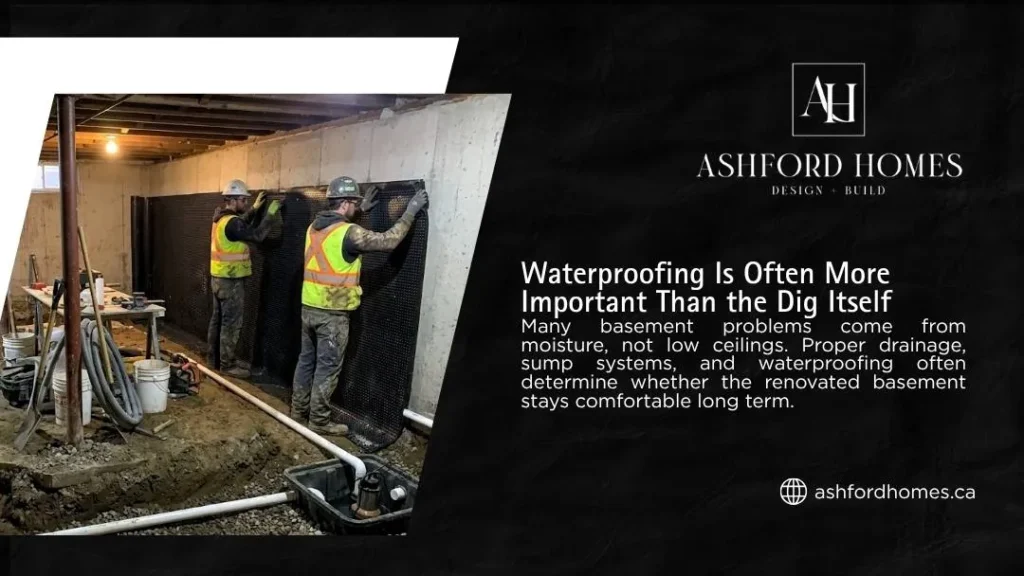
| Waterproofing and drainage | Helps protect the newly finished basement from moisture | A beautiful basement that still smells damp or takes on water |
| Plumbing and drains | Supports bathrooms, laundry, kitchens, floor drains, and backwater protection | Expensive rework after the slab is poured |
| New slab and floor prep | Creates the base for the finished basement floor | Comfort, moisture, and finish problems later |
| Finishing | Turns the structural shell into usable living space | A tall basement that still does not function well |
A stronger way to budget is to ask: What will it cost to create the basement I actually want? That answer is different for every home. A structural dig is one price. A finished basement is another. A legal basement apartment is another thing again.
This is why Ashford Homes is better positioned as a planning partner, not just a quoting option. For a homeowner, the goal is not to buy the cheapest dig. The goal is to avoid regret. That means understanding the full path before construction begins.
When underpinning pays off
Underpinning pays off when it gives the home something valuable that it does not have now. That could be headroom, function, comfort, rental potential, resale appeal, or enough space to avoid moving.
For many West Toronto homeowners, the decision is not only financial. It is also emotional. They may not want to leave the neighbourhood. They may not want to give up the school, the street, the neighbours, the garden, or the short walk to the subway. If the basement can solve the space problem, moving may no longer be the only answer.
Underpinning can also make sense when the home’s main floors already work well, but the basement is holding the property back. A low, unfinished lower level can make an otherwise beautiful house feel incomplete. A finished basement with better ceiling heights can make the whole property feel more balanced.
| Homeowner situation | Why is underpinning worth it |
| Low basement ceiling heights | The space can become comfortable enough for daily use |
| Need for more living space | The family gains square footage without changing the home’s footprint |
| Desire for rental income | More height may support a legal basement plan, subject to code and permits |
| Strong neighbourhood value | Usable square footage can support long-term resale appeal |
| Moisture or foundation concerns | The project can pair structural work with drainage and waterproofing upgrades |
This is the heart of the decision. Underpinning works best when it is part of a bigger home strategy, not a one-off construction choice. Homeowners can see how basement work connects with broader renovations by reviewing Ashford Homes’ completed home renovation projects.
When is underpinning not worth it?
Basement underpinning may not be worth it if the basement already has usable ceiling heights, the homeowner has no clear plan for the space, or the total project cost does not make sense for the property.
It may also be the wrong move if the home has more urgent issues elsewhere. A failing roof, outdated electrical system, serious drainage problem, or poorly planned main floor may need attention before the basement becomes the priority.
This is where homeowners often worry: What if I spend all this money and still do not love the basement? That fear is reasonable. Underpinning should not begin until the homeowner knows what the finished space is supposed to do.
If the goal is storage, laundry, or occasional use, a lighter renovation may be enough. If the basement already has decent headroom, better lighting, insulation, flooring, waterproofing, and a smarter layout may deliver better value than structural lowering.
A good contractor should be honest enough to say when underpinning is not the best option. That kind of honesty does not weaken the sale. It builds trust.
Underpinning vs bench footing: which one makes more sense?
Underpinning and bench footing both address low basement height, but they do it differently. Underpinning extends the basement foundation downward beneath the existing footing. It usually preserves more floor area and gives the basement a cleaner finished shape. This often makes it the better choice for homeowners who want a polished finished basement, legal basement potential, or maximum usable square footage.
Bench footing, sometimes called benching, lowers the central basement floor while leaving a concrete bench around the perimeter to support the existing foundation. It may cost less in some homes, but it takes away floor space near the walls.
| Method | Best for | Main trade-off |
| Underpinning | Maximum space, better ceiling heights, legal basement potential, higher-end finishing | Higher cost and more engineering complexity |
| Bench footing | Some height gain with less foundation disruption | Lost square footage around the walls |
| No lowering | Basements with adequate height or simple use plans | May not solve comfort, resale, or code-related goals |
In narrow Toronto basements, the lost space from benching can be more frustrating than homeowners expect. A ledge around the room may affect furniture, storage, bathroom layout, and how open the basement feels.
That is why the choice should come after a site visit, not before one. The right method depends on the foundation, soil, target ceiling heights, budget, and the finished use of the basement.
Permits, engineers, and Toronto building code concerns
Basement underpinning in Toronto requires proper permit planning because it affects the structure of the home. The residential underpinning identifies building permit approval as the service outcome for this type of work.
The City’s documentation also notes that underpinning drawings may need to show proposed underpinning locations, support columns, structural framing, numbered stages of work, lineal metres of underpinning, distance to adjacent foundations, and footing depth where applicable.
A Professional Engineer may be required when the proposed foundation work goes below the level of an adjacent footing and falls within the soil’s angle of repose. Toronto’s building documentation also states that, where applicable, underpinning and related construction must be designed by a Professional Engineer.
For a homeowner, this means permits are not red tape to get around. They are part of protecting the house. If a contractor treats permits as optional, that is a warning sign.
The same care applies when the goal is a legal basement. Toronto’s secondary suite guide describes a secondary suite as a second dwelling unit inside an existing detached house, semi-detached house, or townhouse, and says a basement apartment is a common example. The guide also asks for drawings that show floor-to-ceiling heights, stairs, guards, handrails, wall and floor assemblies, foundation details, and other code-related items.
Underpinning can help with a legal basement, but it does not create one by itself. The full plan must address building code, fire safety, exits, plumbing, heating, ventilation, electrical work, ceiling heights, and layout.This is another reason Ashford Homes’ full-renovation approach matters. A basement cannot be planned in isolation if the goal is a comfortable, safe, code-conscious lower level. Homeowners with early planning questions can start with Ashford’s home renovation FAQ.
Rental income and legal basement potential
Rental income is one of the biggest reasons homeowners ask whether basement underpinning is worth it in Toronto. A low basement may not feel suitable for tenants, guests, or family. Lowering the floor can help create the ceiling heights and comfort needed for a more livable lower level.
But the money side deserves careful thought. A legal basement is not just a finished basement with a kitchen. It is a regulated dwelling space that must be planned properly.
The secondary suite requires drawings and details related to proposed use, floor-to-ceiling heights, stairs, guards, handrails, building assemblies, and life-safety items. That means rental income depends on compliance, not just good finishes.
A lawful basement apartment may help offset renovation costs over time. It may also appeal to future buyers who want a flexible living space. But homeowners should also account for privacy, sound transfer, maintenance, insurance, taxes, tenant access, and whether the home layout truly works for a separate unit.
For some families, the smartest value is not immediate rental income. It is flexibility. The basement might serve as a rental suite now, then become space for aging parents, adult children, guests, or a home office later. That long-term flexibility is often where underpinning becomes more than a cost. It becomes a way to make the home adapt.
How to choose basement underpinning Toronto contractors
The right basement underpinning Toronto contractors should be judged by process, not only price. A contractor who gives a quick number without studying the house may not be protecting the homeowner.
A proper contractor should ask about the existing foundation, desired ceiling heights, basement floor condition, drainage, access, neighbouring structures, waterproofing, future use, legal basement goals, and whether the project connects to a larger renovation.
The best contractors slow the decision down before they speed the project up. Our vetting checklist for Toronto renovation contractors walks through the questions, licences, and references that separate a thorough builder from a fast talker. That same care should show up on paper, so it helps to understand the key clauses in an Ontario renovation contract before committing to a quote. That is exactly what nervous homeowners need. They need someone who can explain the risks, the order of work, the likely surprises, and the true cost range before demolition begins.
| Red flag in a quote | Why should homeowners worry |
| The price is much lower than other quotes | An important scope may be missing |
| Engineering is not clearly mentioned | The structural plan may be weak or incomplete |
| Waterproofing is treated as an afterthought | The basement may still have moisture problems after finishing |
| Permit support is vague | The homeowner may face delays or compliance issues |
| The quote does not separate structural work from finishing | The final cost may be unclear from the start |
| The contractor promises a legal basement without reviewing code requirements | Legal suite approval involves more than ceiling height |
This is where Ashford Homes can be positioned as the safer, more complete choice. The company’s strength is not just construction. It is the ability to look at the home as a whole: structure, design, permits, function, budget, and long-term use.
Is it worth the dig? A practical homeowner’s answer
Is basement underpinning worth it for Toronto homeowners? Yes, when it gives the house something meaningful: usable square footage, better ceiling heights, a dry finished basement, rental potential, stronger foundation performance, or enough room to avoid moving.
It is less likely to be worth it when the project starts with no clear plan. A deeper basement should not be the goal. A better home should be the goal. The smartest approach is to look at the whole property. How long will the family stay? What does the home lack now? Would a finished basement solve a daily problem? Could rental income help? Does the neighbourhood support the investment? Will waterproofing, drainage, plumbing, HVAC, stairs, and design all be considered from the start?
Those questions matter because underpinning is not just a technical job. It is a homeowner’s decision with money, comfort, safety, resale, and lifestyle all tied together.
For many older Toronto homes, the basement is not wasted space. It is unfinished potential. With careful planning, proper permits, experienced trades, and a contractor who understands the whole home, underpinning can turn that potential into space the household actually uses.
A better basement starts with a better plan
So, Is Basement Underpinning Worth It Toronto? Yes, when it is planned with care and tied to a real purpose. It can create more living space, improve comfort, support rental potential, strengthen the lower level, and help a family stay in a home and neighbourhood they already love.
But it should never begin with guesswork. The right decision starts with a careful look at the home, the foundation, the budget, the permits, and the future use of the space.
Ashford Homes brings the kind of full-home thinking this project deserves. Rather than looking at underpinning as a standalone dig, the team can help homeowners understand how the basement fits into the larger renovation picture: structure, layout, light, moisture control, code, finishes, and long-term value.
If your basement feels too low, too dark, or too limited, the next step is not to guess whether underpinning is worth it. The next step is to find out what your home can realistically become. Start the conversation with Ashford Homes.
