
Most Toronto homeowners want a clear answer before they open up the basement floor: how long does basement underpinning take, and what can slow it down? The short answer is that the structural work often takes 4 to 8 weeks, while the full project can take 3 to 6 months or more once design, engineering, permits, inspections, waterproofing, drains, and finishing are included.
This article explains the real basement underpinning timeline in Toronto, what affects it, how permits and soil conditions shape the schedule, and why Ashford Homes looks at underpinning as part of a bigger home renovation plan, not just a foundation job.
How Long Does Basement Underpinning Take?
So, how long does basement underpinning take in practical terms? For many Toronto homes, the structural underpinning process itself takes around 4 to 8 weeks after permits are approved and the site is ready. Smaller basements with straightforward access may move faster. Larger basements, deeper digs, older foundations, waterproofing, drain relocation, and a finished basement buildout add time.
A Toronto-focused guide gives a useful construction-only benchmark, noting that a typical basement underpinning project takes 4 to 8 weeks, with smaller 400–600 square foot basements around 3–4 weeks, medium basements around 5–6 weeks, and large 1,000+ square foot basements around 6–8+ weeks. It also notes that permit approval can add extra time.
Construction time and total project time are not the same thing. If someone asks, how long does basement underpinning take? they might mean the dusty part in the basement. But if they mean the real-life timeline from first consultation to usable space, the answer is longer.
| Project stage | Typical Toronto timeline | What happens |
| Initial review and scope | 1–3 weeks | Site visit, goals, ceiling height, budget, access, rough feasibility |
| Engineering and drawings | 2–6 weeks | Structural drawings, design coordination, and existing foundation review |
| Permit application and approval | 4–10+ weeks | Toronto Building review, forms, possible revisions, and engineer documents |
| Structural underpinning work | 4–8 weeks | Sectional excavation, new footings, concrete, and inspections |
| Waterproofing, drains, and rough-ins | 1–4 weeks | Drainage, plumbing, waterproofing, and mechanical adjustments |
| Basement finishing | 4–12+ weeks | Framing, insulation, electrical, drywall, flooring, trim, finishes |
A safe planning range for a full basement lowering and renovation in Toronto is often 3 to 6 months, while a larger project with full interior finishing, rental-suite requirements, or complex approvals may need more time. The industrial guide separates the work in a similar way: 2–4 months for pre-construction and 4–8 weeks for structural underpinning only.
Basement Underpinning Timeline at a Glance
Before getting into permits, soil conditions, and construction details, it helps to separate the structural work from the full renovation timeline. Most confusion starts when those two timelines get mixed together.
| Question | Practical Answer |
| How long does basement underpinning take? | Most structural underpinning work takes 4 to 8 weeks after the drawings and permit are ready. |
| How long does the full basement project take? | A complete basement lowering project often takes 3 to 6 months, depending on design, permit review, inspections, waterproofing, drains, utilities, and finishes. |
| What usually slows the work down? | Permit revisions, soil conditions, tight access, old drains, engineer review, inspection timing, and late changes to the finished basement plan. |
| Can the timeline be shortened? | Some planning steps can be handled efficiently, but the structural phase should not be rushed. |
| Why does Ashford Homes fit this type of project? | Ashford Homes looks at underpinning as part of the whole home, including layout, plumbing, lighting, waterproofing, comfort, structure, and long-term use. |
That bigger-picture view matters in West Toronto, where many older homes have low basements, narrow access, and layouts that no longer suit modern family life. The basement may become a guest suite, rental unit, office, gym, or larger family space. Ashford Homes plans basement projects with those future uses in mind, so the work below the foundation supports the way the home needs to function above it.
Why the Timeline Varies From House to House
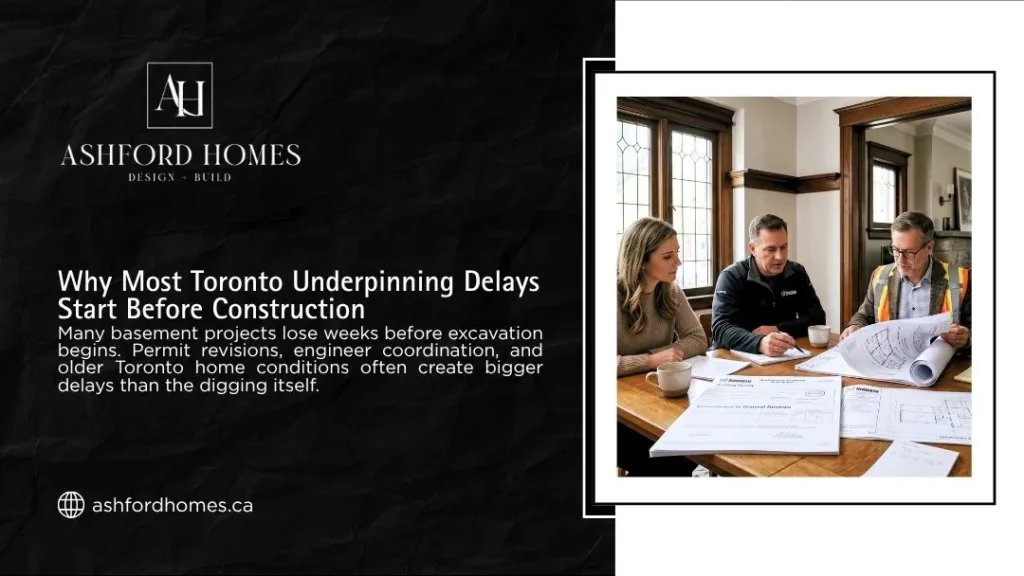
The short answer is helpful, but it doesn’t tell the whole story. How long does basement underpinning take when the house is over 100 years old, the ceiling height is very low, or the existing foundation is fragile? That’s where the details matter.
Basement underpinning varies based on the size of the basement, desired depth, soil conditions, access, utilities, structural engineer requirements, permit application reviews, inspections, and whether the basement will be finished after the structural work. In West Toronto, many houses have older foundations, narrow lots, shared or nearby walls, and limited exterior access. Those factors can slow the work, but they also make careful planning more important.
Basement size and square foot area
A small basement does not take as long as a large one, but the difference is not always linear. Underpinning work is usually done in controlled sections, not by digging out the entire foundation at once. Crews excavate beneath the existing foundation in stages, reinforce and pour one section, allow it to set, then move to the next planned section.
A 500 square foot basement with clean access may be far simpler than a 900 square foot basement with a low ceiling, old rubble foundation, drain relocation, and limited room for material removal. That’s why square foot area is only one part of the estimate.
Soil type and soil conditions
Soil conditions can change quickly. The City of Toronto warns that the angle of repose depends on soil conditions and that disturbing soil within that zone can cause soil failure with serious consequences. It also states that if construction exceeds the guidelines or the soil type is unknown, a professional should prepare the design drawings.
In simple terms, the crew needs to know what the ground can safely support before excavating beneath the existing foundation. Sandy soil, clay, high moisture, unknown fill, and tight neighbouring foundations can all affect the underpinning process.
That is not a bad thing. It is part of doing the work safely. The goal is not just to lower the floor. The goal is to lower it without compromising the house.
Desired ceiling height
The deeper the dig, the more time the work may take. Many Toronto homeowners want to lower the basement floor to create a comfortable ceiling height, especially if they plan to convert the basement into living space. A modest increase can be simpler than a deeper excavation that requires more soil removal, more underpinning depth, more drainage work, and more coordination with a structural engineer.
The goal should not be as deep as possible. It should be the right ceiling height for the use of the room, the home’s structure, the site conditions, and the budget.
Access, utilities, and drainage
Basement underpinning gets slower when crews have limited access for soil removal, concrete, tools, and materials. Many Toronto homes do not have wide side yards or easy machine access. If everything must move through a narrow entrance or by hand, the schedule changes.
Utilities also matter. Plumbing stacks, drains, electrical service, HVAC equipment, water lines, and sewer connections may need to be protected, rerouted, or upgraded. If the homeowner also wants waterproofing, a sump pump, a backwater valve, radiant floor heat, or a new basement bathroom, the work becomes more than underpinning alone.
This is one reason Ashford Homes treats basement lowering as a design-build conversation. Underpinning affects the way the future basement will live, not just the way the foundation sits.
Engineering and permit application
Toronto requires a building permit for basement underpinning. The City’s building permit lists basement underpinning, excavating or constructing foundations, basement entrances, and second suites among the types of work that require a permit.
The City also says underpinning drawings may need professional engineer involvement, and in some cases, a foundation must be designed and reviewed on-site by a Professional Engineer. This is one of the biggest reasons how long does basement underpinning take has no one-size answer.
A Realistic Basement Underpinning Timeline in Toronto
If your project is in Toronto, it helps to think in phases. A contractor may be able to give a rough schedule after the first visit, but a reliable timeline usually comes after the structural engineer, drawings, and scope are clearer.
| Timeline scenario | Structural work only | Total likely project time | Best fit |
| Simple small basement | 3–5 weeks | 2–4 months | Clean access, modest depth, minimal extras |
| Standard Toronto underpinning | 4–8 weeks | 3–6 months | Typical older home, permit, inspections, and waterproofing |
| Large or complex basement | 8–12+ weeks | 6–9+ months | Deep dig, poor access, utility changes, full finishing |
| Basement suite conversion | 8–16+ weeks construction | 6–12+ months | Underpinning plus separate entrance, fire/code upgrades, kitchen, bathroom |
Start with a consultation and scope review before locking in dates. Their renovation process is a helpful place to understand how a full project moves from idea to plan to construction through a managed renovation path.
What Happens During the Underpinning Process?
The underpinning process starts long before the first shovel hits the basement floor. First, the homeowner and contractor clarify the purpose of the project. Is the goal more ceiling height, a legal basement apartment, a family room, a gym, better structural integrity, or a full lower-level renovation? Those decisions affect design, cost, permit needs, and timing.
Next, the project team reviews the existing basement size, foundation type, access, mechanical systems, drainage, and soil conditions. A structural engineer may then prepare drawings that show how the home will be supported while crews excavate beneath the existing foundation.
Once permits are approved, the physical work usually follows a staged sequence. The basement is prepared, demolition or slab removal begins, and crews excavate sections beneath the existing footings according to the engineer’s plan. New footings are poured in sections. Each section must gain enough strength before adjacent sections are opened. This is why a responsible contractor will not dig the entire perimeter at once.
After the underpinning sections are complete, the project may move into waterproofing, drainage, gravel, vapour barrier, insulation, plumbing rough-ins, slab pour, framing, electrical, HVAC, drywall, flooring, and finishes. If the basement is part of a larger renovation, the timeline may overlap with other parts of the house.
For homeowners who want the project handled as part of a larger renovation, Ashford Homes’ design-build and renovation services can help integrate the basement work with the rest of the home, rather than treating it as an isolated job.
Toronto Permits, Engineers, and Inspections
This is where many timeline estimates fall apart. A contractor might say the physical work can take six weeks. That may be true once everything is approved. But construction should not begin until the structural plan, permit application, and inspection path are properly handled.
The City of Toronto requires a building permit for underpinning an existing house foundation. Its residential underpinning explains that the work may require professional engineering input and proper construction drawings.
Toronto also includes underpinning under its building permit fee schedule. As of the 2026 fee, underpinning is listed at $12.37 per linear metre. That city fee is only one part of the budget. It does not include engineering, design, excavation, concrete, waterproofing, drains, labour, finishes, or revisions.
A permit is not red tape for the sake of red tape. In underpinning, it is part of risk control. It protects the homeowner, the neighbouring property, and the long-term structural integrity of the house. The right question is not How soon can someone dig? The right question is What does the home need before the work starts?
How Cost and Timeline Work Together
Homeowners often search for how long does basement underpinning take, right before they search for lower basement floor cost, cost of lowering basement floor, or basement underpinning Toronto cost. The reason is obvious. Time and budget are tied together.
A faster project is not always a cheaper or better project. If a contractor skips engineering, rushes concrete cure time, ignores soil conditions, or starts without proper documentation, the homeowner may face expensive structural problems later. On the other hand, a well-planned project can reduce avoidable delay because drawings, scope, access, and finishes are settled earlier.
| Cost factor | How does it affect the timeline | Why it matters |
| Basement size | A larger footprint usually takes longer | More excavation, more sections, more concrete |
| Excavation depth | Deeper lowering adds work | More soil removal and more structural coordination |
| Soil conditions | Poor or unknown soil slows decisions | May require engineer review or soil testing |
| Access | Tight access adds labour time | Soil and material removal take longer |
| Waterproofing | Adds time but can prevent future issues | Often smart to do while the basement is open |
| Plumbing and drains | Can add days or weeks | Bathrooms, laundry, sump pumps, and backwater valves need coordination |
| Finishing level | Major impact after structural work | A finished suite takes far longer than a raw, lowered basement |
If the goal is a clean, livable, dry, code-conscious basement, the better question is not only how long does basement underpinning take? It is what timeline gives this house the safest and most useful result?
Ashford Homes’ portfolio of completed renovation work shows how lower-level improvements often connect with bigger whole-home goals, especially in older Toronto houses where layout, structure, and function need to work together.
What Can Delay a Basement Lowering Project?
Even with good planning, a basement lowering project can hit a few bumps once the floor is opened up. Most delays are not dramatic; they usually come from small site realities that need the right fix before work can safely move forward.
| Delay Factor | What It Usually Means | How It Can Affect the Timeline |
| Incomplete permit documents | Drawings, forms, or engineering details are missing or unclear. | The project may pause before approval or need revisions before work starts. |
| Engineer-requested changes | Site conditions do not match the original assumptions. | The structural plan may need updates before the next stage can continue. |
| Poor or unknown soil conditions | Soil is loose, wet, unstable, or different from what was expected. | Excavation may slow down so the home stays properly supported. |
| Tight access | Soil, concrete, and materials must move through narrow paths or stairs. | Labour takes longer, especially in older West Toronto homes with limited side access. |
| Old drains or plumbing conflicts | Existing drain lines sit where the new work needs to happen. | Plumbing may need to be moved, replaced, or coordinated with the new slab height. |
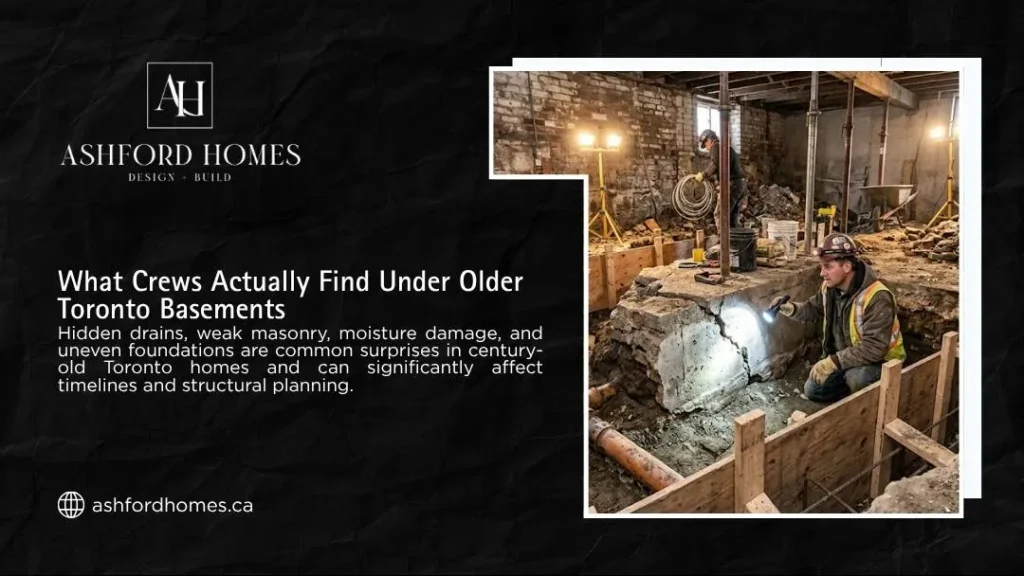
| Hidden foundation issues | Crews uncover cracked footings, patchwork, weak masonry, or past repairs. | Extra review or repair work may be needed before underpinning continues. |
| Moisture or waterproofing problems | Water entry, damp walls, or poor drainage become visible during excavation. | Waterproofing or drainage upgrades may add time, but they can prevent bigger issues later. |
| Inspection scheduling | Required inspection points do not line up with the construction pace. | Crews may need to pause until the inspection is completed. |
| Late design changes | The homeowner changes the basement layout, bathroom location, or finishing plan. | Drawings, trades, materials, or permits may need updates. |
| Utility interruptions | Electrical, HVAC, water, or sewer lines need protection or relocation. | Work may slow while trades coordinate safe access and service changes. |
A good project manager will not pretend that these issues never happen. The real value is in spotting them early, explaining the options clearly, and keeping the basement-lowering schedule as steady as the house allows.
How to Plan a Smoother Underpinning Project
A smoother project starts with honest planning. Before asking for a start date, ask what must happen first. A reputable contractor should review the structure, access, permit needs, engineering path, timeline risks, and budget range before giving a confident schedule.
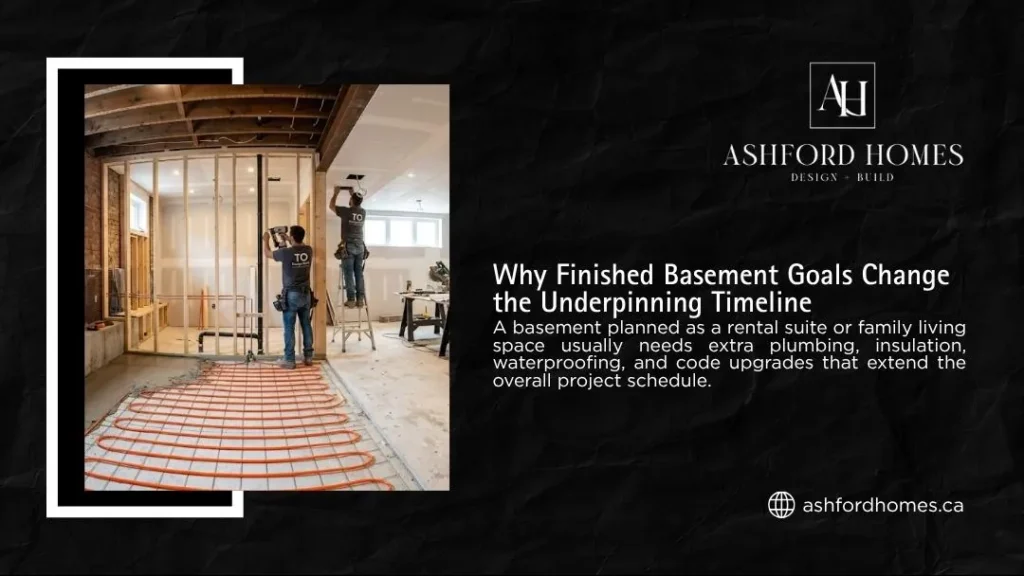
The homeowner should also be clear about the future use of the basement. A storage space does not need the same design as a rental suite. A gym does not need the same plumbing plan as a guest suite. A family room may have different lighting, insulation, and ceiling goals than a legal apartment.
For Toronto homeowners, it also helps to think beyond underpinning. If the basement will eventually need waterproofing, new drains, a bathroom, laundry, or a separate entrance, doing the work in the right order can prevent rework. That is where a renovation company with broader project experience can be helpful.
FAQs About Basement Underpinning Timelines
What is the cost of lowering the basement floor in Toronto?
The cost of lowering basement floor space in Toronto varies based on square foot area, depth, soil conditions, access, engineering, waterproofing, and finishing. Many competitor guides place basement underpinning Toronto cost in broad ranges, but homeowners should request a site-specific quote because two basements with the same square footage can have very different structural and access conditions.
Can basement underpinning be rushed?
It should not be rushed. Underpinning involves excavating beneath the existing foundation and building new support below it. Skipping engineering, opening too many sections, or rushing concrete work can create structural risk. A safe schedule is better than a fast promise.
Is basement underpinning worth it?
It can be worth it when the basement has low ceiling height, the home needs more usable space, or the owner wants to add long-term value without building outward. It is most worthwhile when the project is planned with drainage, structure, layout, and future use in mind.
Who should I contact for a basement underpinning project?
Start with a renovation team that understands older Toronto homes, permits, structural coordination, and full project planning. If you are still at the research stage, our checklist for vetting a renovation contractor in Toronto covers the credentials, contracts, and questions that reveal whether a team is up to the job. You can contact Ashford Homes to discuss whether underpinning, basement lowering, or another basement renovation approach makes sense for your home.
Make Your Basement Project Worth the Wait
The real answer to how long does basement underpinning take is this: the structural work may take a few weeks, but the right project deserves a full plan. In Toronto, a realistic schedule should account for engineering, permit application, inspections, soil conditions, basement size, waterproofing, utilities, and the finished purpose of the space.
A rushed basement-lowering project can create problems that cost far more than the time it saved. A well-run project gives you a safer structure, better ceiling height, stronger long-term use, and a basement that finally feels like part of the home.
If you are planning to lower your basement floor, add living space, or explore a full lower-level renovation, speak with Ashford Homes and start with a proper review of your home, goals, and timeline.
