
A low basement can hold back an otherwise solid Toronto home. The ceiling feels tight, the layout is awkward, and the space often becomes storage instead of a real living area. That is why many homeowners compare basement underpinning vs bench footing Toronto before they commit to a basement lowering project.
In this article, we will break down how both methods work, what they cost, how they affect floor space, when each option makes sense, and what Toronto homeowners should know about permits, engineers, and long-term value before choosing a contractor.
Basement Underpinning vs Bench Footing Toronto
Basement underpinning is the deeper structural route. It involves digging below the existing foundation in carefully staged sections, then forming and pouring new footings beneath the old ones. Once that new support is complete, the basement floor can be lowered while the foundation walls remain properly supported.
The City of Toronto gives a clear definition that matters here: Underpinning is a method of increasing the depth of an existing foundation by constructing new footings beneath the existing footings. That official description also notes that underpinning may reinforce an existing foundation or support a below-grade entrance.
Bench footing works differently. Instead of placing new support under the existing foundation, contractors dig down inside the basement and build a concrete bench or ledge along the interior walls. That bench supports the soil and footing beside it.
It can be a practical method in some houses, especially where the owner wants a lower basement floor without the same level of foundation excavation. But the trade-off is obvious once the room is done: the bench takes up usable floor space.
Here’s the thing. In Toronto homes where every foot matters, that concrete ledge is not a small detail. It can affect furniture placement, storage walls, bathrooms, bedrooms, and rental-suite layouts.
| Factor | Basement Underpinning | Bench Footing |
| Main method | Extends the foundation downward with new footings under old footings | Lowers the floor inside the existing foundation and adds a concrete bench at the perimeter |
| Floor space | Keeps more usable square footage | Reduces usable floor space near walls |
| Ceiling height | Usually better for full-height basement plans | Can improve height, but may limit layout |
| Cost | Usually higher | Usually lower |
| Structural impact | Can strengthen your foundation when engineered well | Avoids digging under the existing foundation |
| Best use | Full basement conversion, rental suite, long-term value | Budget-conscious basement lowering where space loss is acceptable |
| Visual result | Cleaner, open basement walls | The perimeter ledge must be designed around |
What Basement Underpinning Does for Older Toronto Homes
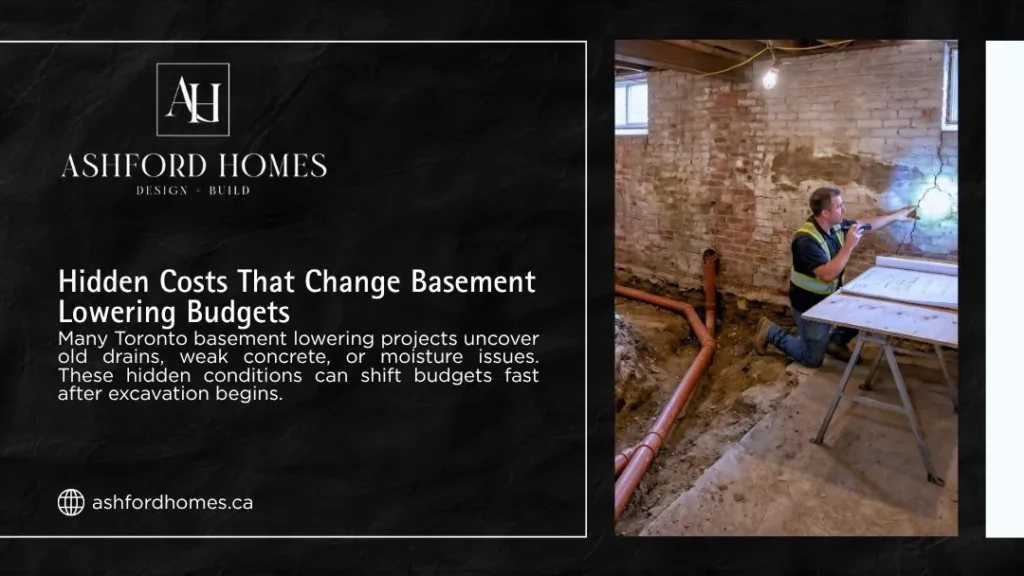
Many older homes in Toronto were built with basements that were never meant to be true living areas. They were for storage, boilers, laundry, coal rooms, and utility access. That is why the ceiling height often feels cramped. Underpinning gives homeowners a way to turn that low basement into real living space without adding to the footprint of the house.
The underpinning method can create a flatter, more flexible room. Since the work happens beneath the foundation walls, the finished basement does not need a thick concrete shelf around the edges. This is one reason underpinning is often preferred for a legal rental suite, media room, bedroom layout, gym, or open family space.
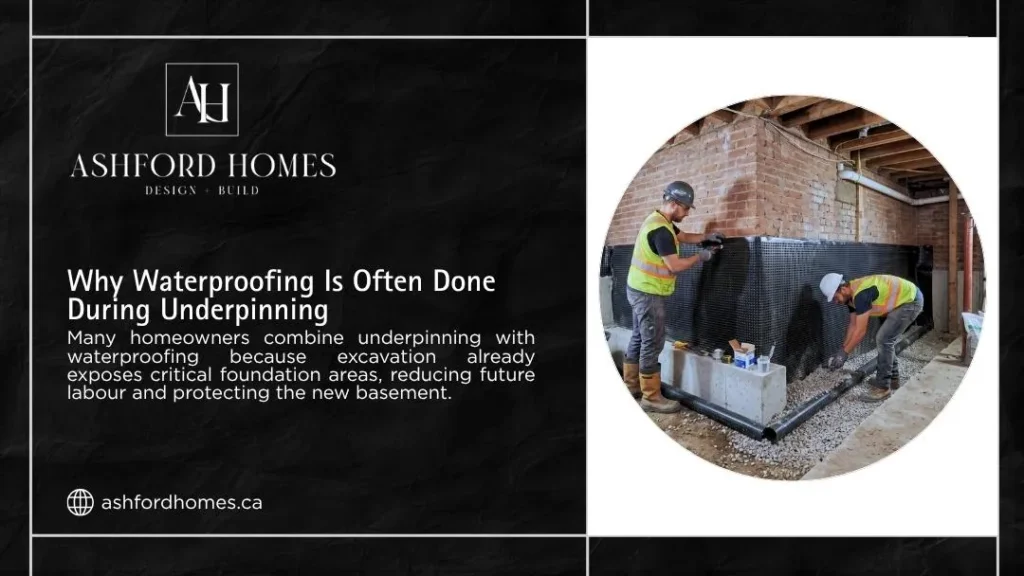
It also has a structural upside. When designed and built by qualified professionals, foundation underpinning can strengthen your foundation, improve support, and allow other work such as waterproofing, drainage upgrades, a new slab, and better insulation. That does not mean it is simple.
Underpinning involves digging in sections, engineering review, temporary support, concrete work, inspections, and strict sequencing. It is not weekend renovation work, and frankly, it should never be treated that way.
For homeowners planning a major renovation, Ashford Homes presents basement underpinning as part of its broader home renovation services in West Toronto, with emphasis on added ceiling height, foundation support, and more functional lower-level space.
What Bench Footing Means in a Basement Renovation?
Bench footing, or foundation benching, is often presented as the easier cousin of underpinning. In some cases, that is fair. The existing foundation is not excavated from below, which can reduce complexity and cost. The basement floor is lowered inside the footprint, then a reinforced concrete bench is built along the perimeter to support the soil and old footing.
This can help when a homeowner wants more headroom but cannot justify the budget for full underpinning. It may also come up when soil, neighbouring foundations, or engineering limits make underpinning less attractive.
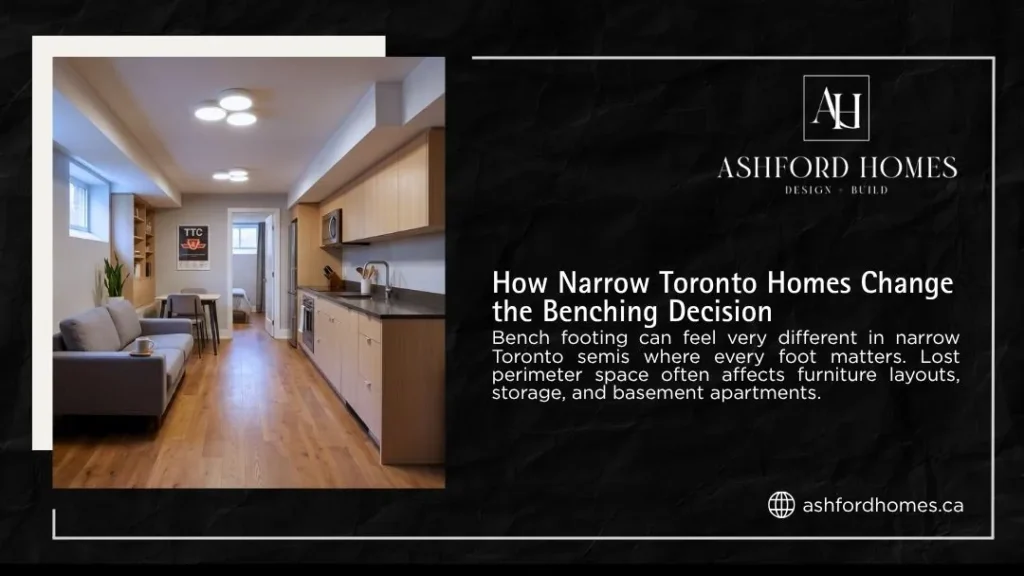
But benching a basement has one big drawback: the bench becomes part of the room. It might be boxed in, used as a shelf, hidden with millwork, or worked into storage, but it still takes square footage. In a narrow Toronto semi or row house, that can make a finished basement feel pinched. A bench can also complicate basement bathrooms, closets, beds, sofas, built-ins, and code-related clearances.
So, yes, a basement bench footing can be useful. But it is not simply underpinning for less money. It is a different layout result.
When Bench Footing Makes Sense
Bench footing is not the wrong choice just because it costs less. In the right basement, it can be a practical way to gain height without rebuilding the foundation from below. That matters for Toronto homeowners who want a better lower level but do not need every inch of perimeter space.
It may make sense when the basement is wide enough to absorb the ledge, the planned use is simple, or the budget does not support a full underpinning project. A laundry area, storage room, workshop, playroom, or casual media space may still work well with a bench along the walls. In some homes, site conditions may also make benching a more realistic option after an engineer reviews the foundation.
The key is honesty at the planning stage. If the bench will block furniture, limit a bathroom layout, or make a future rental suite feel cramped, the lower upfront cost can become less attractive. Ashford Homes’ approach is to look at the finished room first, then match the structural method to the way the space needs to be used.
When Underpinning Is Usually Worth It
Underpinning is usually worth a closer look when the basement is meant to become a true living level, not just a cleaner utility space. If the plan includes a bedroom, bathroom, family room, home office, gym, or rental suite, the extra room around the walls can make a major difference.
Because underpinning supports the foundation from below, the finished basement can feel more open and easier to design. That can help with furniture placement, interior walls, storage, plumbing runs, and the overall flow of the lower level. In older Toronto homes, especially in neighbourhoods such as Roncesvalles, High Park, The Junction, Bloor West Village, Swansea, and Baby Point, that extra flexibility often matters more than homeowners expect.
The higher cost has to be weighed against long-term use. A basement that is easier to furnish, easier to finish, and easier to enjoy may offer better value than a cheaper project that leaves the room awkward.
This is where Ashford Homes’ planning-first process helps: the structure, budget, layout, and final purpose are reviewed together before the basement floor is lowered.
Underpinning vs Benching: Cost, Space, and Value
Cost is usually the first question, and rightly so. Basement lowering is structural work, not a surface renovation. Toronto-area contractor guides commonly place underpinning above bench footing because it requires staged excavation, engineering, concrete work, inspections, and careful support of the existing foundation.
One local cost guide lists underpinning-only work at roughly $90–$150 per square foot and bench footing alternatives around $70–$110 per square foot, with the final number shaped by basement size, soil, permits, waterproofing, drainage, and access.
Those figures should be treated as planning ranges, not a quote. A century home in The Junction, a narrow semi near Roncesvalles, and a detached home in Bloor West Village can all price differently. Soil conditions, disposal, slab depth, drain work, waterproofing, structural drawings, and neighbour conditions can shift the budget quickly. That is why a proper assessment should come before a firm decision.
| Basement Goal | Better Direction | Why |
| Create a legal rental suite | Usually underpinning | A cleaner layout, stronger ceiling height, and better use of the room can help with suite planning. |
| Build a simple laundry or storage area | Bench footing may work | The space does not need the same open layout as a bedroom or living room. |
| Add a family room or home office | Often underpinning | Furniture, lighting, and movement through the room are easier without a perimeter bench. |
| Lower the basement on a tighter budget | Bench footing may work | It can reduce cost if the home and layout can handle the ledge. |
| Improve long-term resale appeal | Often underpinning | A more open lower level usually feels more finished and easier to use. |
Which Basement Lowering Option Fits Your Home Best?
| Question | Better Fit May Be Underpinning | Better Fit May Be Bench Footing |
| Do you need maximum floor space? | Yes, because a no-perimeter bench reduces the room | Not ideal, because floor space is lost |
| Is this for a rental suite? | Often better because layout and ceiling height matter | Possible, but the bench may limit the room design |
| Is the budget the main constraint? | Harder to justify if funds are tight | Often more affordable |
| Is the foundation fragile or complex? | Needs engineer review; may still be possible | May be considered if digging below footings is not advised |
| Do you want the cleanest finished look? | Usually yes | Only if the bench is carefully designed into the room |
| Are you planning long-term resale? | Often, a stronger value due to space and layout | Can add utility, but with layout trade-offs |
The best answer is not the same for every house. Underpinning vs benching depends on what the finished basement has to do. A playroom can tolerate compromises that a legal suite cannot. A storage and laundry zone does not need the same clear span as a bedroom, kitchen, and bathroom plan.
That is why Ashford Homes’ renovation process fits this kind of decision. The team does not treat basement lowering as concrete work alone. The conversation starts with how the homeowner wants to use the space, then moves into structure, permits, budget, layout, and construction planning. That is a more practical way to decide between underpinning and bench footing because the right method should support the finished room, not just the excavation plan.
Permits, Engineers, and the Toronto Reality
Basement lowering affects the structure of a house, so permits are not a side detail. In Toronto, they are part of doing the work properly. The City of Toronto lists residential underpinning as a building permit matter and states that a Professional Engineer is required when a foundation is built below the level of an adjacent building’s footing and within the angle of repose of the soil.
In that case, the design must be sealed by a Professional Engineer, and the engineer must sign the required general review commitment for the permit application.
That requirement matters in older Toronto neighbourhoods where houses often sit close together. A semi-detached home, row house, or narrow lot leaves very little room for guesswork. Digging too deep, too fast, or without proper review can affect foundation walls, neighbouring footings, drainage, soil stability, and structural integrity. A serious contractor will not brush those risks aside.
Lowering Basement Floor Without Underpinning: Is It a Good Idea?
Lowering the basement floor without underpinning usually means bench footing or another engineered alternative. Yes, it can be done in some homes. But it is not automatically the best route.
Bench footing may make sense if the homeowner can live with less floor space, the basement is wide enough to absorb the ledge, the planned use is simple, and the engineer agrees that leaving the existing foundation in place is the right move. It may also help when the budget does not allow full underpinning.
But for narrow Toronto homes, that lost square footage can sting. Once drywall, insulation, mechanicals, stairs, laundry, and a bathroom enter the plan, every inch counts. A bench can turn what looked like a spacious basement on paper into a room with awkward corners and limited furniture placement.
That is why bench footing vs underpinning should be reviewed with the finished layout in mind, not just the excavation method.
Pros and Cons for Toronto Homeowners
| Method | Pros | Cons |
| Underpinning | More open floor plan, better use of square footage, can strengthen your foundation, strong fit for rental suites, and major renovations | Higher cost, longer timeline, more engineering and inspection needs |
| Bench footing | Often lower cost, may be faster, avoids excavation beneath the old footing, useful where underpinning is not practical | Reduces floor space, creates a visible ledge, can complicate layouts, and may feel less polished |
| Hybrid or partial approach | Can solve specific access, walkout, or headroom issues | Needs careful design; not every home is suited to partial structural work |
In many Toronto homes, the best value is not the cheapest method. It is the method that leaves the basement useful after the money is spent. A basement with good height but poor layout can still feel like a compromise. A basement with slightly higher upfront cost but better living space may be easier to furnish, rent, sell, and enjoy.
Ashford Homes’ portfolio of West Toronto renovations shows the kind of finished-space thinking that matters here. Basement work should not be planned as concrete work alone. It should be planned as part of the whole home.
Which One Should You Choose?
Choose an underpinning if the basement needs to feel like a proper living level. It is usually the stronger option for homeowners who want a family room, guest space, bedroom, home office, gym, or rental suite. The cleaner perimeter gives the design more room to work, and that can make the finished basement feel less like a dug-out space and more like part of the home.
Choose bench footing if the budget is tighter, the room is wide enough to handle the ledge, and the planned use is more modest. It can be a sound option when designed properly. The catch is that the bench must be planned into the layout from the start, not treated as something to hide later.
For anyone comparing basement underpinning vs bench footing Toronto, the smartest move is to begin with the finished room. Decide what the basement needs to become, then work backward through ceiling height, foundation walls, square footage, waterproofing, permits, drains, stairs, and budget. The method should fit the house and the homeowner’s goals, not the other way around.
FAQs About Basement Underpinning and Bench Footing
Is bench footing cheaper than underpinning?
Usually, yes. Bench footing often costs less because it avoids digging under the existing foundation. The trade-off is lost floor space and a less open basement layout.
Does underpinning add more usable space?
In most cases, yes. Underpinning lowers the basement floor while keeping the perimeter more open, which protects usable square footage.
Can a bench footing create a legal basement apartment?
It may, but the full design must meet all applicable code, height, egress, fire separation, plumbing, and permit requirements. The bench can affect the layout.
Which method is safer?
Neither method is automatically safe without proper design. Underpinning and bench footing both need qualified professionals, engineering review where required, and careful construction.
Can I live in the house during the basement lowering?
Sometimes, but it depends on project scope, dust, noise, temporary services, safety controls, and structural work. Ask the contractor and engineer before assuming it is practical.
Is underpinning worth it for resale?
It can be, especially when it creates a dry, full-height, usable basement. The value depends on quality, permits, layout, finish level, and local market demand.
What is the biggest downside of benching basement space?
The concrete bench reduces floor space and can make layouts harder, especially in narrow Toronto homes.
Plan the Basement Before You Price the Dig
Basement underpinning vs bench footing Toronto is not just a technical comparison. It is a decision about comfort, safety, layout, budget, and how much value the lower level can add to the home. Underpinning often gives a cleaner and more flexible result. Bench footing can still make sense when the site, budget, and room plan support it.
The risk comes from choosing too early. A low quote can look attractive until the finished basement loses too much space. A more expensive method can also be hard to justify if the room only needs basic utility. The better path is to assess the basement first, then choose the method with clear eyes.
If you are weighing underpinning against bench footing, start with a proper basement assessment before you price the work. Ashford Homes can help review ceiling height, foundation conditions, layout goals, permit needs, and the best way to turn your lower level into usable space. Speak with Ashford Homes about your West Toronto basement renovation and plan the work with the finished room in mind.
