
For most people, a renovation is the second-biggest purchase they’ll ever make. But it doesn’t come with the legal protections of buying a house. There’s no closing lawyer by default. No standard set of rules. Just you, a contractor, and a piece of paper.
That paper matters more than most people think.
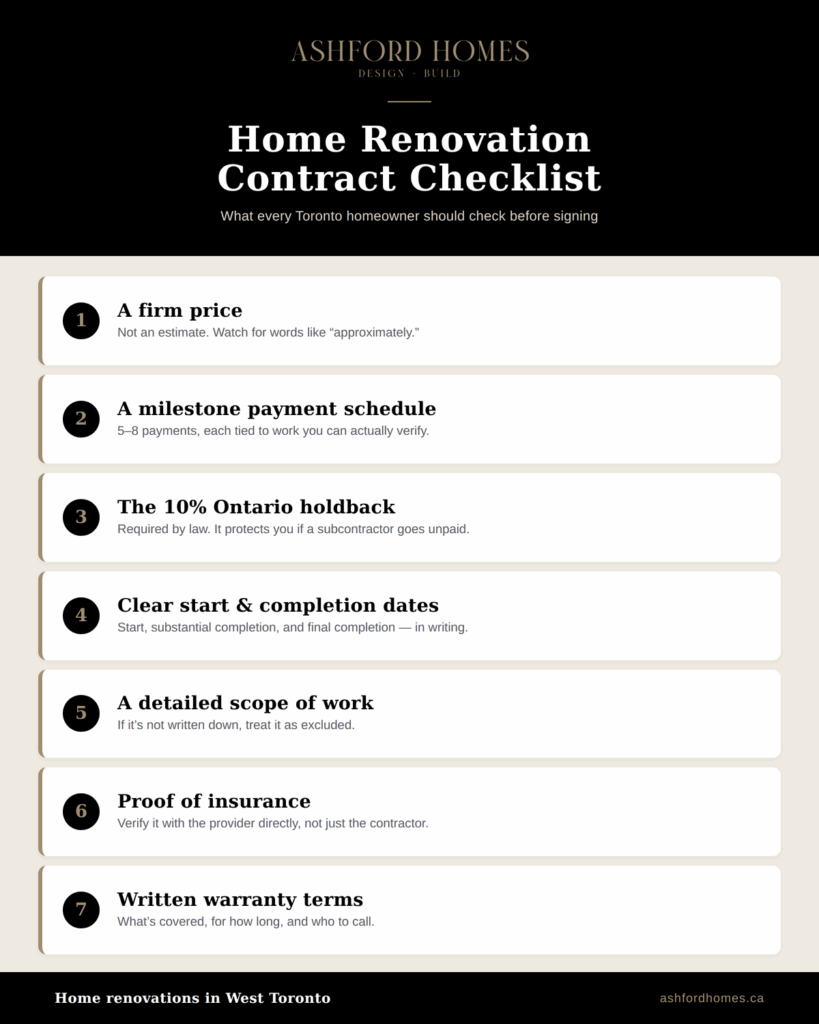
Short answer: A good home renovation contract should spell out a firm price, a payment schedule tied to real milestones, clear start and completion dates, a detailed scope of work, the 10% holdback required under Ontario law, and warranty and insurance terms. If it’s not written down, assume it’s not included.
Here’s what to look for, and why each part protects you.
Why the contract matters so much
An Ipsos survey on Toronto renovations found some numbers worth pausing on. 69% of homeowners had trouble finding a contractor they could trust. 73% ran into problems during the work. And 9% had a contractor take a deposit and disappear.
You can’t remove all risk. But a clear contract removes a lot of it. It sets expectations on both sides and gives you something to point to when things get fuzzy. Good contractors want this too. A detailed contract protects them as much as it protects you.
Price and payment
Ask for a firm price, not an estimate. Watch for words like “approximately” or “around.” Those words can move, and they usually move up.
Payments should follow a schedule, not a lump sum. Five to eight payments is common. Each one should be tied to a milestone you can actually see and check, like “framing complete” or “cabinets installed.” That way you’re paying for work that’s done, not work that’s promised.
Be careful with large upfront deposits. A contractor who wants a big percentage before starting is asking you to carry the risk. A fair schedule keeps the money moving in step with the work.
The 10% holdback
This one is specific to Ontario, and a lot of homeowners have never heard of it.
Under Ontario’s construction lien rules, you’re required to hold back 10% of the contract value for a set period after the work is substantially done. It protects you if a subcontractor or supplier isn’t paid. Your home renovation contract should name this holdback clearly. If it doesn’t mention it at all, that’s a flag.
Timeline and delays
Your home renovation contract should list three dates: when the project starts, when it’s substantially complete, and when it’s fully finished.
It should also deal with delays. Some delays are fair, like a supply issue nobody could predict. Others aren’t. A solid contract separates the two and says what happens when a delay isn’t excusable. Without that, “we’re running a bit behind” can stretch for weeks with no consequence.
Scope of work
This is where most disputes start.
Write down everything you discussed. Every fixture, every finish, every small ask. If it’s not in the scope, treat it as excluded. “Work as discussed” is not a scope. Memories fade, and a handshake doesn’t hold up when there’s a disagreement three months in.
A good scope also says what’s not included. That sounds negative, but it prevents surprises. It should connect to your building permits, too, so the paperwork matches the plan.
The more you include upfront, the fewer change orders you’ll face later. Change orders are where budgets quietly grow.
Insurance and warranty
Ask for proof of insurance, and verify it with the provider directly, not just the contractor. A certificate is easy to hand over. A quick call confirms it’s real and current.
Your home renovation contract’s warranty terms should be in writing. What’s covered, for how long, and who to call if something goes wrong after the crew leaves. A contractor who stands behind their work will have no problem putting this on paper.
Communication and process
The best projects run on clear communication. Look for a contractor who uses project management software, so messages, decisions, and changes are documented instead of lost in texts.
Ask for a shared schedule you can see any time. When you can check progress on your own, you spend less time chasing updates and more time trusting the process.
Do your homework first
A little due diligence before signing saves a lot of grief later.
Let the contractor do a preliminary inspection so hidden issues turn up before the work starts, not halfway through. You can check building permit history through the City of Toronto’s website. And for a project this size, having a lawyer review the contract is money well spent.
The bottom line
A home renovation contract isn’t just paperwork. It’s the plan for how your money is spent and your home is treated. Get it in writing, keep it specific, and don’t rush the parts that feel tedious. Those are usually the parts that protect you most.
Frequently asked questions
What should a home renovation contract include?
A firm price, a milestone-based payment schedule, start and completion dates, a detailed scope of work, the 10% Ontario holdback, warranty terms, and proof of insurance.
How much deposit should I pay a contractor?
Avoid large upfront deposits. A fair contract ties payments to completed milestones, usually across five to eight payments, so you’re paying for work that’s actually done.
What is the 10% holdback in Ontario?
Ontario’s construction lien rules require you to hold back 10% of the contract value for a set period. It protects you if a subcontractor or supplier goes unpaid.
Should a lawyer review my renovation contract?
Yes. A renovation is often the second-largest purchase you’ll make. A lawyer’s review is a small cost next to the amount you’re spending.
What happens if the work isn’t written in the contract?
Assume it’s excluded. If something you discussed isn’t in the scope, get it added in writing before you sign.
About Ashford Homes
We’re a home renovation company based in west Toronto. We live and work in the same community we build in, so our name is on the line with every project. If you’re planning a renovation and want a clear, honest contract to start from, get in touch for a conversation.
